Custom Software Development Step by Step – Part 2: Feature List, Planning, and Methodologies
In the first part, we looked at how an idea is born and how it can be shaped into clear, measurable goals. This is the foundation on which all custom software development is built.
Now, we move forward and focus on how these goals can be translated into concrete features, the role of planning in success, and how various software development methodologies help ensure that the project becomes a working system that generates real business value.

Custom software development is not just a technical issue: a well-defined feature list, conscious planning, and the right choice of methodologies ensure that the system fits the needs of digital transformation and data-driven decision-making. Whether it is mobile app development, report generation, or building scalable data-driven systems, everything depends on a solid foundation.
What should the software be capable of? – Feature List
When the need for a new system arises, the next step is always to precisely define: what should the software be capable of. This is where custom software development becomes truly tangible. The feature list at this stage is like a shopping list, as every item on it brings you closer to the final, functional solution.
The feature list is not just a technical detail. If you build on a solid foundation, you will end up with exactly what you need in your project - without unnecessary features. For example:
- login with multiple permission levels,
- order tracking or a customer portal,
- report generation that supports data-driven decision-making,
- mobile application development with supplementary features.
A well-prepared feature list also ensures that the project costs do not escalate because it clarifies expectations upfront.
Behind the Scenes of Planning
After the feature list comes the design phase. This is where decisions are made about what the interface looks like, what processes the user goes through, and how all of this fits into the company’s system.
During the design phase, wireframes, user journeys, and prototypes are created. These help visualize how the software will look and function in reality. Changes are much cheaper and faster to make at this stage than during coding, so flexibility is the key here.
Tip: Always think from a business perspective, not just by looking at screenshots. The goal of good design is for the software to create real value – for example, by speeding up report preparation or supporting data-driven decision-making.
EN-CO example: During the design phase of our Invoice Receipt AI development, we discovered that due to manual matching, it often took days to close the accounting process. In a client meeting, it became clear that if administrators could see invoices and related payments in a single interface, it would not only speed up the work but also significantly reduce errors. We built this insight into the system – proving how important the design phase really is.
Methodologies and Models – How to Work?
After the planning phase, another big question arises: how to carry out the development? Custom software development is not based on a single template. There are several software development methodologies and models, each advantageous in different situations.
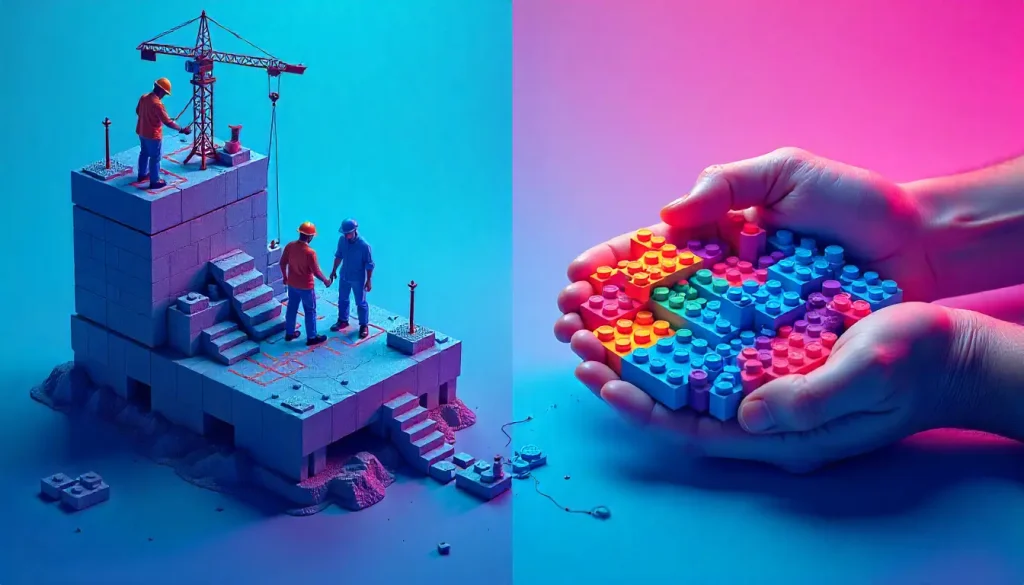
Waterfall model: every step is planned in advance, sequentially. It's like construction: once the foundation is done, the walls come next, then the roof. This approach is stable but less flexible.
Advantages:
- Clearly structured process,
- Easier to estimate costs and timelines in advance,
- Detailed documentation is created, which is useful later.
Disadvantages:
- Inflexible, hard to make changes during the process,
- Errors often only discovered at the end,
- Minimal client involvement, which can be risky for long projects.
Agile methodology: progress is made in short cycles (sprints), always testing and refining. It is like building with LEGO: you first create a smaller part, then gradually expand it. The advantage of agility is that it quickly responds to changing needs.
Advantages:
- flexible, easily adapts to changing requirements,
- provides continuous feedback, allowing earlier detection of errors,
- active client involvement, resulting in a better-fitting final product,
- working parts become available faster.
Disadvantages:
- less predictable costs and deadlines,
- often incomplete documentation,
- client availability is critical,
- not always ideal for large, regulated projects.
When a company is facing digital transformation, agile operations often prove to be more effective. In such cases, the role of the system integrator becomes more valuable, as they not only need to coordinate development but also the entire ecosystem — including existing systems, reporting tools, and mobile applications.
Tip: There is no universal recipe. Choose the model that fits your company’s operations and scalability needs.
- If you are a startup operating in a fast-changing, competitive market or a digital service company where customer needs often change, the Agile methodology can provide an advantage because it flexibly responds to changes.
- If you are a medium-sized commercial or service company where both stability and certain flexibility are needed, it is often worth applying a hybrid model (e.g., agile development combined with waterfall-like project management).
- If you work in a large corporate, regulated environment — such as developing banking, healthcare, or industrial systems — where errors pose serious risks, the Waterfall model may be more effective because it provides predictability and strict control.
Now that you have a clearer view of the role of features, planning, and methodologies, we have reached the point where plans turn into real lines of written code.
In the continuation, we will show how development takes place and why no successful project can exist without thorough testing.
[banner type="enco" text="Without planning, development turns into expensive experimentation." button="Request a planning consultation!" link="https://encosoftware.hu/en/contact"]