Hungarian company, international team – how to make every company document clear
Have you ever had to explain the essence of a Hungarian policy to a foreign manager in a separate call or email?
Is it familiar when a decision is delayed because everyone is reading a different language version of the same document and no one is quite sure they are looking at the same content?
In this article we show how you can bring your multi language company documents into order so that every member of your team can quickly get a reliable answer in their own language from the same knowledge base.
Why is this a real business risk today?
As a decision maker you have probably seen situations like these:
A new foreign manager arrives but the monthly report is in Hungarian
You are the one who has to prepare a separate English summary for every report because the numbers alone are not clear enough. After a while you realise this is no longer strategic work. You have become an internal interpreter.
A key client sends a contract amendment from abroad
You know that a single misunderstood sentence in the terms can cost money. The legal team is overloaded, translation takes time, your answer is delayed while the client is expecting a quick reaction.
Technical documentation in a foreign language, Hungarian maintenance tea
An error message appears on a machine and the solution is buried somewhere in a several hundred page document. The shift leader is taking photos, asking questions, making guesses while production is at a standstill because nobody can see the whole picture.
In all these cases the problem is not the lack of information. It is that:
- the knowledge is not available in the language people are actually working in,
- the same thing has to be explained multiple times to multiple people,
- decisions are delayed while responsibility still sits on your shoulders,
- sooner or later someone will paste the document into a public AI tool just to finally get some sort of answer.
What do you actually want?
You want everyone to work quickly, in their own language, from the same reliable knowledge while AI integration remains secure and transparent.
The goal is clear and the solution already has a name
The problem and the goal are both clear. The only question is the solution. Or maybe not. The market has already given many names to this need such as robot assistant or document search system.
EN-CO combined its positive and negative experiences with seven years of knowledge to create MIRA. It is a chat based AI assistant built on top of your organisation’s accumulated knowledge. It works with internal documents, policies, contracts, technical descriptions as well as structured data and reports.
You simply ask your question in your own language and MIRA:
- understands what you are asking
- finds the relevant documents
- summarises the key points
- shows you which source it used for its answer
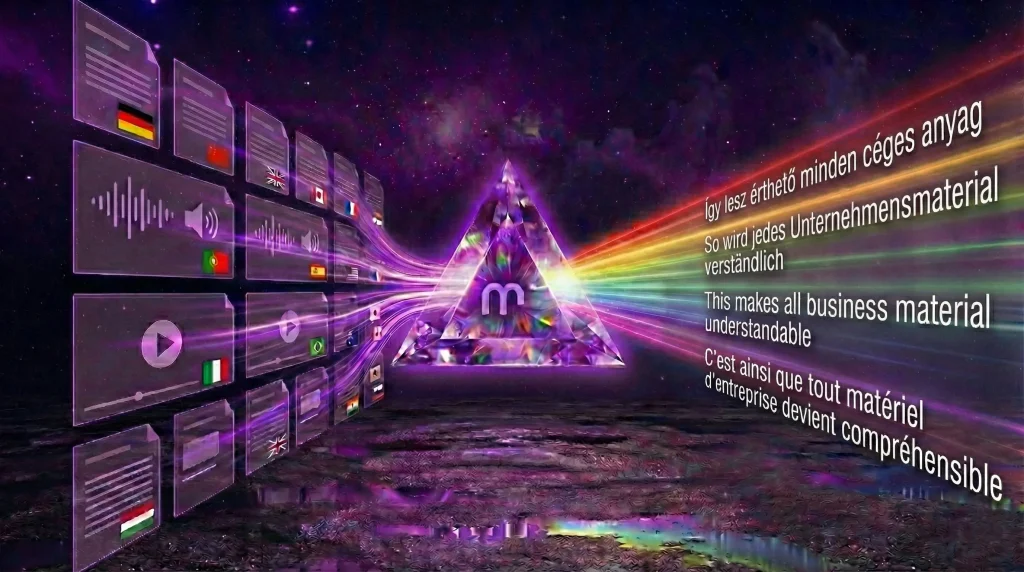
It makes no difference whether the source is in Hungarian, English, German or even Chinese. MIRA understands the content and replies in the language you used for your question. And this is only the tip of the iceberg. It does not stop at written documents. It also automatically transcribes audio recordings and video calls, so the content of an important meeting or online discussion becomes just as searchable in your knowledge base as a contract or a technical manual.
Three projects where MIRA has already proven itself
Hungarian company, English speaking CFO
At a Hungarian service company the finance team had always prepared monthly reports in Hungarian. The law required it and this was how they worked efficiently. When a new English speaking CFO joined, more and more explanatory emails and extra calls were needed to make the background of the reports clear.
After MIRA was introduced the finance process itself did not change. Reports were still created in Hungarian. The CFO however no longer sent long emails with questions. Instead he typed his questions in English in the MIRA interface, for example about the margin drop of a specific product. MIRA generated an English summary based on the Hungarian report and its comments, highlighted the relevant explanations and showed which lines and notes it relied on. According to the finance leaders this significantly reduced the number of follow up clarification emails and made the monthly review process smoother.
Hungarian project manager, German contract amendment
In a project based cooperation the partner sent a contract amendment in German. Two online meetings were held to discuss the changes. The calls were recorded but listening back and taking detailed notes would have taken too much time so the team often only remembered fragments.
Once MIRA was introduced, the contract text and the meeting recordings were both loaded into the platform. MIRA transcribed the meetings and aligned the content of the two calls side by side as V1 and V2. The project manager then asked in Hungarian what had changed between V1 and V2 in terms of penalties, deadlines and key terms. MIRA highlighted the modified sections, produced a Hungarian summary and pointed to the exact clauses where the changes appeared. The legal team could then focus only on the critical passages instead of translating and rereading the full material from scratch.
Manufacturing company with English technical documentation
At a production company the complete technical documentation for key equipment was only available in English while most of the maintenance team worked in Hungarian. When an error code appeared the solution was hidden somewhere inside a several hundred page manual. In practice this meant a lot of guesswork and long periods of downtime.
After MIRA was introduced these documents were uploaded into the platform. The next time an error code appeared the shift supervisor typed the question in Hungarian in MIRA. The platform found the relevant section in the English documentation, summarised the necessary steps in Hungarian and clearly indicated which chapter it was based on. According to the maintenance team this reduced the time spent on trial and error and made downtimes measurably shorter in critical cases.
MIRA does not gossip – it keeps all your information in house
MIRA uses artificial intelligence in a way that leaves the control firmly in your hands. It can run on your own servers, in an on premise setup or in your chosen cloud environment, depending on your security and compliance requirements.
You can define access based on roles and logging shows exactly who asked what and which documents MIRA relied on. Your data never leaves the closed MIRA environment. There is no need for public AI tools and you can avoid so called Shadow AI where colleagues paste company information into external services such as ChatGPT.
MIRA does not invent information. It only relies on the internal sources you have provided. Every answer it gives is backed by a specific, traceable document. This offers a solid foundation for decision preparation because the AI is not hallucinating. It is working from real, verifiable data.
In this way AI integration does not add extra risk. It creates a transparent, auditable way of working.
Where is the return on investment most visible?
- Time
Less translation, fewer explanatory meetings and less ad hoc document hunting. If a foreign manager or a project team asks just a few questions a day through MIRA you can already see measurable time savings within a few weeks.
- Decision quality
There are fewer misunderstandings and lower risk around contracts, configurations and operational decisions. MIRA cites its sources with each answer so even in a later dispute you can go back and see exactly what information the decision was based on.
- Security and compliance
MIRA runs on your own infrastructure. You do not have to worry about sensitive documents leaking through improvised solutions. Logging and access control support your compliance requirements, audits and internal policies. In this way AI integration is not a risk factor but a controlled improvement.
When is it time to act?
It is worth considering MIRA when the bottleneck is no longer the lack of information but the way multi language knowledge reaches your team.
If several of these sound familiar it is probably time to move:
- different Hungarian, English or German answers are prepared to the same question yet you are still not sure everyone understands the same thing
- months after a meeting in a foreign language you still need a lot of explanatory emails and extra calls to clarify what the reports actually mean
- contract amendments, audits or incidents drag on because the essentials are scattered across foreign language documents and recorded meetings
- more and more of your time is spent finding and interpreting documents and less and less is left for actual decisions and execution
If these signs are present in your organisation it is worth looking at an AI solution that builds on your own knowledge base, makes multi language documents searchable in one place and keeps the entire AI integration inside your own environment and under your control.
Curious to see in which areas MIRA could give you a tangible competitive advantage?
Visit the MIRA website, use the contact page to reach out, and together we can look at your own cases to see where it can add the most to your everyday decisions.