Digital Amnesia 2026 – A single retiring key expert can cost the company 16–25 million HUF
The retirement of a single senior expert, even with a planned handover, has a tangible P&L (Profit & Loss) impact. When critical knowledge gets stuck in knowledge silos, the company loses the ‘why’ behind key decisions.
The duration of the safety overlap is often 2–3 months, during which you carry two fully loaded employment costs for the same position because, without the departing expert, the successor isn’t confident taking ownership.
In this article, we calculate the hidden overhead of parallel operations and present a 38.5 million HUF example of what happens without knowledge retention.

Why is this a critical business risk in 2026?
If you cannot reach your most experienced engineer or chief accountant tomorrow, and no one can tell you why the system works the way it does, that’s not a headcount issue. It is a business continuity risk. Mid-sized companies feel it the most.
Three factors make this a leadership-level issue today.
- The demographic wave – Large cohorts are reaching retirement in waves. With them, the logic of 20–30-year-old systems disappears, which is the classic loss of tribal knowledge.
- SPOF (Single Point of Failure) – This is the weakest link in the system, where the fate of a process depends on the presence of a single person. If a key person in a production line section or a legacy IT system becomes unavailable, it can disrupt operations and create immediate costs.
- Permanent knowledge loss – Retirement is not reversible. If decision logic is not captured during offboarding, the organization loses its institutional memory.
Cost Model – How much does replacement cost in a standard case?
The direct cost of generational change is the planned overlap. For safety, you pay the departing and the arriving expert simultaneously for months.
The model below is based on a monthly fully loaded employment cost of 2 million HUF. These figures are illustrative estimates; the actual amount depends on the salary level and the length of the overlap.
- Replacement cost (6–12 M HUF) – Headhunter fees and the cost of lost time.
- Safety overlap (6 M HUF) – 3 months of parallel employment costs. This is the pure premium for knowledge continuity.
- Onboarding productivity loss (3.6–6 M HUF) – The new colleague works at full cost to the company for 6 months but only at 30–50% efficiency. This is the productivity gap.
- Mentor load (1.2 M HUF) – The time of senior colleagues spent on training instead of core work.
Replacing a single key position thus means 16–25 million HUF in direct, near-term costs. This is a structural expense, not identical to the motivational loss discussed in our article on the Silent Layoff phenomenon.
Illustrative example – When the bill is 38.5 million
A Central European example highlights the order of magnitude of the risk.
- Company & Role: 250-employee manufacturing plant, specialized Maintenance Manager — a classic Single Point of Failure (SPOF).
- Risk Event: a 9-month search and hiring process, a 5-month forced overlap (re-hiring the departing expert as an external consultant), plus a 12-hour production downtime due to missing documentation.
- Total Financial Impact: 38.5 million HUF.
How does this number add up?
The breakdown below is an illustrative estimate, based on a realistic industrial scenario:
- Consultant re-engagement (15.0 M HUF): bringing back the retired expert as an external consultant to close critical work.
(Calculation: 5 months × 3.0 M HUF/month = 15.0 M HUF)
- Cost of downtime (18.0 M HUF): production loss and waste caused by a 12-hour stoppage linked to undocumented knowledge.
(Calculation: 12 hours × 1.5 M HUF/hour = 18.0 M HUF)
- Search & selection (5.5 M HUF): premium headhunter fees and internal costs of a prolonged process (management interviews, HR capacity).
Note: This estimate is intended to show the order of magnitude, the cost of undocumented knowledge typically appears across multiple channels at once.
The Solution – AI-based Enterprise Knowledge Platforms
Why does manual documentation fail? Because operational firefighting is always more important than writing manuals. Moreover, tacit knowledge (professional intuition) cannot be written down in static manuals.
The solution comes from new-generation AI-based knowledge platforms. These systems do not force you to write manuals but record and structure real communication.
We solve this task with the MIRA system.
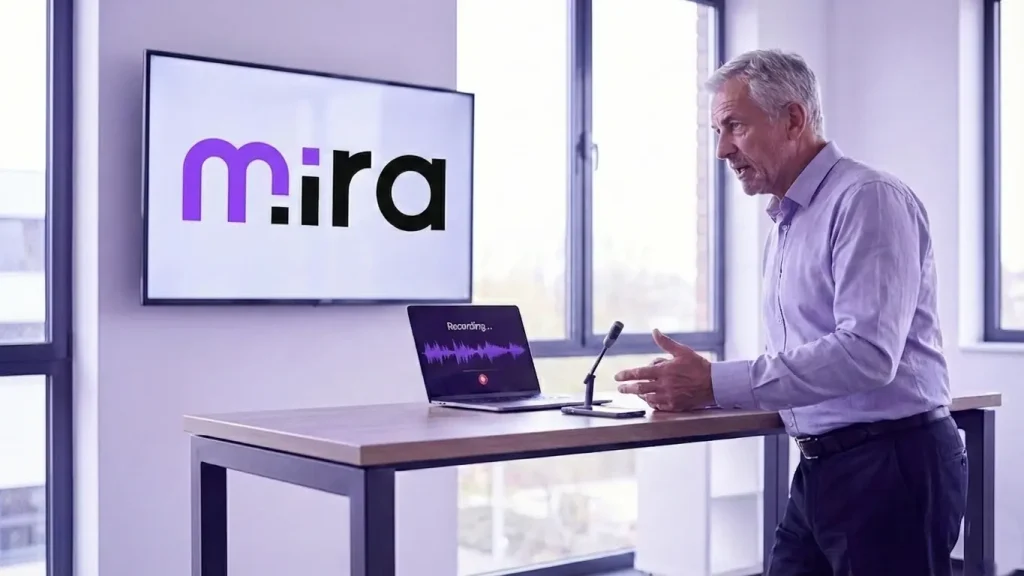
MIRA is not a passive repository but a RAG-based system (Retrieval-Augmented Generation) that uses artificial intelligence to turn spoken handovers into a searchable enterprise knowledge base.
How does it work in practice?
- Recording – The senior expert does not type. They pass on their experience verbally in a casual conversation. The system converts audio and video files into transcripts.
- Data Sovereignty – The solution also runs in an on-premises (on-prem) environment. In this case, data does not leave the company, thus supporting operations according to GDPR requirements. It helps reduce the risks we discussed in our Shadow AI Playbook.
- Trust – The system works from uploaded internal materials and provides source references for answers, making them traceable. This reduces the risk of unverified answers.
- Permissions – Through Active Directory (AD)-based permission management, access aligns with company rules.
ROI and Payback – Through the CFO's Eyes
When does such a system pay off? Due to the scalable pilot option, the system can be launched as a pilot, and the return on investment can be measured in months.
If you reduce the overlap from 3 months to 1 month based on the example above thanks to the queryable knowledge base, that’s 4 million HUF in immediate savings per position. Added to this is the efficiency improvement from onboarding acceleration. An average implementation can thus approach break-even with the successful handover of just the first 1–2 key experts.
Documented knowledge is not administration. It is one of the company's most valuable assets.
[banner type="mira" text="Turn departing expertise into a permanent, searchable business asset!" button="Save the knowledge!" link="https://encomira.hu/contact"]