Decision Memory –Turning meetings into Retrievable Knowledge
Three months after an important decision, often only fragments of arguments remain. The recording exists, but few will spend hours listening back just for a single sentence. This is when it becomes clear why retrievable decision context matters. If the essence is missing from the minutes, the uncertainty and the debate can restart at any time.
A recording on its own does not make information easy to retrieve. It becomes useful when the arguments behind a decision can be quickly retrieved later.
When Minutes Fall Short – The Real Background of Decisions
In the daily rush, documentation is usually the first thing to suffer under time pressure. In many cases, only a few keywords or a half-finished draft remain, but the context and intent are often missing. Notes and recordings then turn into material that is difficult to use.
Without that context, teams are left guessing, which leads to time-consuming extra rounds. This becomes obvious when reopening a supplier decision, justifying a project reschedule, or recalling previous priorities.
Decision Memory in Practice
Decision memory organizes meeting transcripts and related internal materials so that the "why" behind a decision can be retrieved later. Instead of arguing from memory, one can return to the source, reducing uncertainty.
This is where rapid retrieval becomes genuinely useful. The system surfaces the relevant passage and immediately leads back to the point where the reasoning was originally stated.
From Fleeting Words to Traceable Data
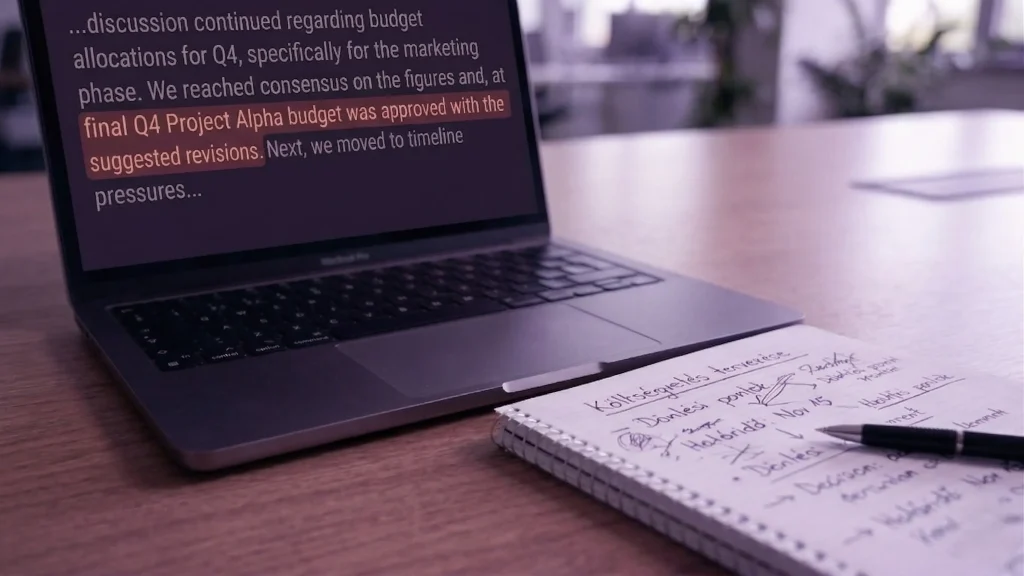
The exact source text displayed on the screen provides a clear reference alongside handwritten notes.
Automatic transcription turns audio and video files into searchable text. However, it is important to see the limitations. Poor quality source material will not yield accurate answers. If internal information is incomplete, reliability may suffer, making source verification indispensable.
The solution leads back to the relevant detail in the transcript and then to the original document or audio segment. There is always a source behind the answer, not just a plausible-sounding statement.
Why Decision Context Matters in Project Handover
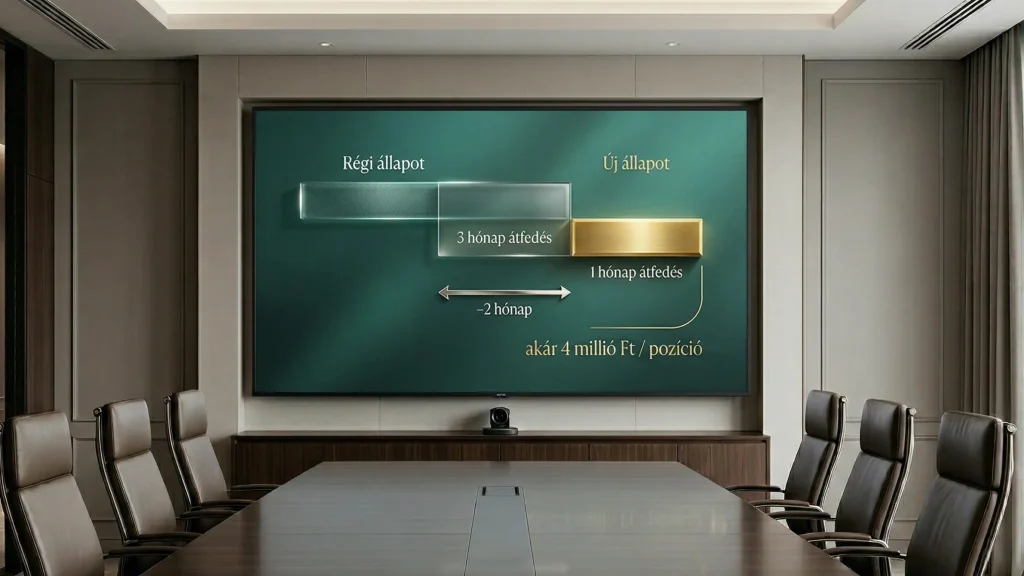
Preserving decision context can create direct financial value. If the reasoning behind decisions can still be retrieved, the handover overlap between onboarding and mentoring can be shortened.
ROI example: Two months less mentoring, 4 million HUF savings per position.
According to a simple example calculation, if the handover overlap drops from three months to one, savings can reach the 4 million HUF range per position.
The basis of the calculation:
- Handover overlap drops from three months to one.
- Calculated with a total employer cost of 2 million HUF per month, resulting in the 4 million HUF range.
The actual amount naturally depends on salary levels and the length of the handover process. Additionally, less time is spent re-explaining the same things, which reduces the burden on key personnel.
Control Instead of Guesswork
If decision backgrounds are retrievable, there is less chance of knowledge getting stuck in a few people's heads. Consider your current operations with three questions:
- How many minutes would it take to find the justification for a decision from last year?
- How much time do people spend re-explaining the same arguments?
- How much does a project handover slip if the logic is not recorded in a retrievable way?
If retrieving the background of an important decision takes a disproportionate amount of time today, it already has business consequences.
Frequently Asked Questions
How is this more than a simple transcript?
It organizes the information and takes you back to the exact point in the original source within seconds.
How does it shorten project handovers?
New colleagues can look up earlier reasoning on their own, requiring less mentoring time for re-explanation.
What are the conditions for reliable operation?
High-quality source material and a secure, closed internal environment where data protection is guaranteed.
[banner type="mira" text="If the reasoning behind decisions is hard to access, the cost of project handover rises quickly." button="Let’s find where time is leaking." link="https://encomira.hu/contact"]